
Stakeholder engagement other than public and carers
The concept of stakeholder analysis is covered in Section 7 Theories of strategic planning
Public and carer consultation and involvement in health service planning
The Principles of Local Accountability and Effective Involvement
The principles outlined within the guidance for Real Involvement are intended to support good governance, decision making and user involvement, encouraging NHS involvement practices to be:
- clear, accessible and transparent
- open
- inclusive
- responsive
- sustainable
- proactive
- focused on improvement.
Building an ‘Involving’ Organisation
Tackling the challenges of developing an organisation that embeds involvement in its core values, behaviours, systems and processes can require sustained leadership and effort over a number of years for some NHS organisations. The following guidance highlights critical factors for success:
A high-performing organisation which,
- Sees its users as a valuable source of information, who are able to provide an insight into their needs and wants, and feedback on their experiences
- Targets people who are ‘easy to overlook’ and those at risk of health inequalities to give them an equal opportunity to get involved
- Invests in developing the capability and capacity of its staff to undertake effective involvement activity
- May consider the benefits of taking a social marketing approach to involvement work
- Undertakes health impact assessment and makes sure it involves the right people
- Makes good use of the intelligence it receives from existing data as well as involvement activity
- Consistently provides an audit trail concerning the processes of involvement
- Utilises a range of techniques to involve users.
Governance
Health service organisations should build user involvement to their governance structures so that there are mechanisms in place for user representatives to be part of the decision-making processes.
Use of existing information
Organisations have central points for recording, collating and updating the large amounts of valuable data about patients experiences in the forms of waiting times, infection rates and self-reported data; current involvement activities; complaints data. Organisations also provide ways to systematically use the data to identify areas for service improvement.
Managers routinely access the data, commission further data-gathering exercises where there are gaps and seek advice from the involvement ‘experts’ and local groups and feed this data into decision-making processes.
Finance
The organisation will require a dedicated and realistic budget allocated for user involvement activities. Training and support for those involved in consultation or engagement may be necessary.
Planning and reporting processes
Considerable effort should be made to scope and plan involvement activity, thinking creatively about the people who may be ‘easy to overlook’ and working with local groups and others to find the most appropriate techniques for involving them. It considers:
- why it is planning involvement activity
- what it needs to find out
- who it needs to involve
- when and how best to reach the right people, especially those who are marginalised and most vulnerable to ill health
- how it will use the information to help it make the best decision, and
- when and how it will feedback to people it has involved to explain what has happened as a result of their involvement.
Working with partners and users
Working with partners requires good communication and the sharing of appropriate and non-confidential information about the needs and wants of people. The organisation may consider reaching out to people in non-health settings through shopping and leisure centres, developing robust and continuing relationships with community groups representing marginalised and vulnerable people. Joint appointments of staff with recognised expertise in user involvement may also provide a useful way to promote a partnership approach.
(For the benefits of joint working see 5b: Understanding Organisations their structure and function - inter-organisational (network) relationships, including intersectoral work, collaborative working practices and partnerships)
Planning Involvement Activity
User involvement activity requires careful planning and NHS organisations should be clear about what they want to achieve. The following set of questions can be used at the planning stage:
- How does this work fit with the organisation’s overall strategy?
- What does the NHS organisation need to know and what do users need to know? e.g. there will be occasions when an NHS organisation may be providing information rather than seeking it.
- What is the cost and what are the benefits?
- How much controversy will it generate (in the light of similar changes, or general issues of trust and confidence in the NHS?
- What work has already been done with users, and what was the outcome?
Carrying out involvement
Whatever the scale of change, NHS organisations will find it helpful to be clear about the process they will use for taking decisions at the start of the involvement process. NHS organisations should aim to have decision-making processes that are open and transparent so users can understand how decisions will be reached and how their views and opinions will be used.
The Involvement Continuum
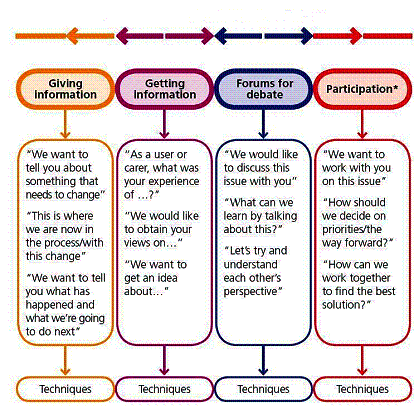
The diagram below shows an involvement continuum with different levels of involvement. The directional arrows are used to indicate where it is possible to slide a technique along the continuum. As one moves towards the direction of participation
there will be more opportunities to become involved in any debate. It includes statements to help identify what can be achieved by using particular techniques at each level.
The major challenges for NHS organisations are to:
- identify and involve the users who are ‘easy to overlook’
- understand users’ lack of knowledge of the planning and commissioning processes in the NHS
- refrain from using jargon and complex language that is difficult for people to understand
- make use of existing non-confidential data on patients’ experiences
- make sure that there is strategic level prioritisation of patient and public involvement
- act on the results of involvement work in the course of making planning and commissioning decisions and monitor this process.
Choosing Techniques
A range of techniques have been identified within this guide which are arranged in sections that relate to the involvement continuum (see diagrams below):
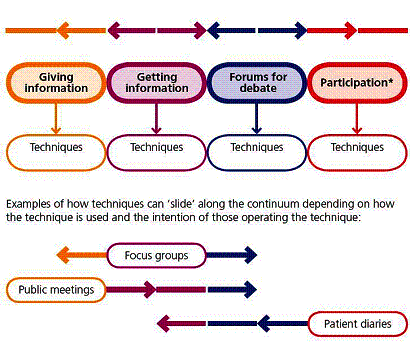
Once the level at which to operate has been determined, organisations are encouraged to develop a set of criteria that reflect the requirements and the context for the involvement activity and use them to help select which techniques or series of
techniques would be best to use.
Consider the example below:
A health service organisation wishes to find out whether a sexual health clinic meets the access needs of young adults, the criteria might include:
- we want to hear the views of young people who are ‘easy to overlook’
- we want to enable participants to voice their own ideas and issues
- the technique has to be suitable for target group – young adults
- it needs to facilitate the capture of the type of information we require (qualitative in this case)
- it must be undertaken within the available involvement budget
- it has to happen within the specified time frame.
For example:
|
Getting information |
Forums for debate |
Participation |
|
|
Displaying information |
Citizens Panels |
Discussion groups |
Co-design/co-production |
|
Use of media |
Focus groups |
Health Panels |
Deliberative events / 21st Century town meeting |
|
Public Meetings |
Surveys/e-surveys |
Nominal group technique |
Citizens juries |
|
Shadowing |
User groups |
||
|
Artwork, photography and other creative means |
Story telling/patient diaries/Blog |
||
|
Mystery shopper |
Participatory appraisal |
||
|
Requested & spontaneous views |
Forum theatre |
||
|
Open surgeries/ conversation cafes |
World cafe |
||
|
Semi-structured one-to-one interviews |
Large group processes – also referred to as citizens summits |
||
|
Peer review |
|||
|
Deliberative mapping |
By plotting the range of techniques that could be used in the left column of the table below, and rating out of 10 the extent to which the techniques meet each criteria – the techniques with the highest scores are those most likely to achieve the best result.
Table based on the work of the New Economics Foundation
|
Technique |
Extent to which technique meets criteria (see above) |
||||||
|
1 |
2 |
3 |
4 |
5 |
6 |
Total |
|
|
Focus groups |
4 |
7 |
6 |
7 |
10 |
10 |
44 |
|
Health panel |
3 |
5 |
5 |
6 |
0 |
10 |
29 |
|
Story telling |
7 |
7 |
7 |
8 |
10 |
10 |
49 |
|
Shadowing |
2 |
1 |
2 |
8 |
10 |
0 |
23 |
|
Blog |
3 |
4 |
7 |
6 |
10 |
0 |
30 |
|
Semi-structured one-to-one interviews |
6 |
5 |
6 |
6 |
10 |
0 |
33 |
In this example the most suitable technique to use is storytelling, followed by focus groups and the least suitable is shadowing and use of a blog.
The review offers a range of techniques that can be viewed as an ‘à la carte’ menu enabling the most suitable approaches for the work in hand to be selected and relate to the involvement continuum.
There are helpful case studies on co production found at http://www.goodpractice.wales/co-production-catalogue-from-wales
© S Markwell 2009, C Beynon 2017