
Understanding Organisations: Structure and management of inter-organisational (network) relationships, including intersectoral work, collaborative working practices and partnerships
Introduction
This review of the structure and management of intersectoral, collaborative and partnership practice is presented in the following sections:
- Definitions of intersectoral, collaborative and partnership working
- Changing philosophy and the development of a collaborative / partnership approach
- Development of collaborative / partnership structures
- Benefits and challenges of collaboration and partnership
Definitions
Inter-sectoral action (ISA) for health:
Denotes a recognised relationship between different parts of the health sector and other sectors in order to achieve health outcomes in a more efficient and effective way than could be achieved by the health sector working alone (Harris et al 1995).
Collaborative Working:
People working across organisational boundaries toward some positive end (Huxham and Vangen 2005).
Partnership Working:
A range of concepts have been used in relation to collaboration and partnership working within public sector discussions and the following terms used throughout this study are abbreviated in the glossary.
- Partner: One who has a share or part with others. The meaning implies the existence of a ‘whole’ of which the partner must be aware (Pratt et al 1998)
- Partnership: An agreement between two or more independent bodies to work collectively to achieve an objective (Audit Commission 1998)
Changing Philosophy and Partnership Development
The developing philosophy of new public health, embraces an evolving paradigm shift from, scientific approaches for problem management to alternative approaches in solution finding.
Table 1: Changing Philosophy (After Jupp, B 2000:15)
|
Business Philosophy |
Social Sector Philosophy |
|
|
1970s |
Conglomerates: |
Central Planning: |
|
1980s |
Single focused organisations: Firms encouraged to ‘search for excellence’ in a core specialism and get out of other activities e.g. IBM held up as exemplar |
Contracting Out: |
|
1990s |
Networks: |
Partnerships: |
|
2000s |
Value Creation: |
Strategic Partnering: |
The current landscape is characterised by a host of complex and seemingly intractable problems and issues e.g. community safety, poverty, social exclusion, health inequalities, teenage pregnancies, urban regeneration, substance misuse, climate change, homelessness. These are often referred to as ‘wicked issues’ because they defy our efforts to delineate their
boundaries and to identify their causes (Rittel and Webber, 1973). Thinking about ‘wicked issues’ requires a language that reflects relationships, interconnections and inter-dependencies – holistic thinking. By the late 1990’s, the emphasis upon collaboration and partnership were identified within policy initiatives linked to health promotion, public health, economic regeneration, and social inclusion.
According to Jupp (2000 p13), the greatest increase in the use of partnership, has been among policy-makers and politicians, with the word ‘partnership’ mentioned 6,197 times in parliament in 1999 up from just 38 times in 1989”. Table 2 reflects this increasing concern of government departments with the promotion of partnership working.
Table 2: Examples of policy documents promoting partnership working
|
World Health Organisation |
2004 |
Global Strategy on Diet, Physical Activity and Health |
|
Scottish Executive |
2004 |
Partnership Working Research Report: Social and Economic Partnership Project |
|
Department for Communities and Local Government |
2007 |
Planning Together Local Strategic Partnerships (LSPs) and Spatial Planning: a practical guide |
|
Department of Health |
2007 |
Family Nurse Partnership |
|
Department of Health |
2009 |
Living well with dementia: A National Dementia Strategy |
|
Department of Health |
2011 |
No Health Without Mental health |
|
World Health Organisation |
2013 |
Global action plan for the prevention and control of non-communicable diseases 2013-2020 |
|
NHS England |
2014 |
Five Year Forward View |
|
World Health Organisation |
2015 |
Global Action Plan on Antimicrobial Resistance |
Development of collaborative / partnership structures
Whilst some people actually use the term collaboration interchangeably with partnership, others may mean cooperation when they say partnerships.
The concept of partnership has important impacts in working practices across many public and private sectors including nursing, health promotion, local government, community development and business. Within these fields people use different forms of wording for the same concept.
Benefits and challenges of collaboration and partnership development
Partnership Stages and Lifecycles
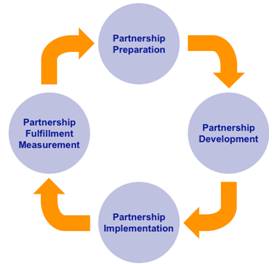
Working through the processes involved in conceptualising, developing, implementing and evaluating partnership progress can be analogous to the kind of processes involved within the basic cycle of experiential learning e.g. formulating abstract concepts and generalisations, testing these implications in new situations, getting involved in the concrete experience and then taking time to observe and reflect upon our experiences and ideas, so too we may move through a cycle or stages within a partnership context.
Figure 1: Partnership Lifecycle
|
Lifecycle |
Summary |
|
Preparation |
Developing a clear picture of what partnerships your organisation needs, what they will deliver and who you will work with |
|
Development |
The process of finding and engaging with potential partners, sharing ideas and reaching a joint agreement |
|
Implementation |
Building on the agreement reached and putting in place the |
|
Fulfilment & measurement |
Delivering the promise. Working together to achieve the benefits agreed in the Development phase and taking opportunities to achieve more |
For further information concerning partnership culture and dynamics please see Health Knowledge: Collaborative Working to Improve Health and Well-being (website address link …)
Benefits
The opportunities that partnership brings are identified by the distinctions made between collaborations which can offer a range of benefits. These new ways of working and thinking in dealing with difficult problems invite presumptions towards innovation, experimentation, risk-taking and entrepreneurship.
Figure 2: Benefits of Collaboration (after Hastings 1996; Mayo 1997; Jupp 2000)
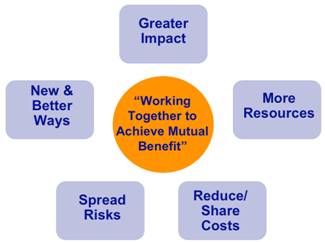
The exposure of different working methods and assumptions of different partners may stimulate innovation and the creation of new perspectives and provide increased reach to disadvantaged populations as well as deliver beyond the capabilities of any one partner.
To pool or spend resources with benefits towards increasing efficiency and effectiveness, and strengthened negotiating power.
3. New and Better Ways
The combination of knowledge, resources, approaches and operational cultures enable partners to create more effective ways of doing things with new perspectives and improved intelligence about needs and opportunities.
The complementary strengths, resources, perspectives offers greater flexibility within a team.
By sharing costs of common functions (in promoting and delivering services, in common systems, e.g. for quality, use of the Internet).
Challenges
“It is one thing to set up a partnership. It is another to develop
the mix of skills, energy and commitment, to make the partnership effective”.
(Markwell et al 2003).
Although partnerships attract additional resources perceived as a strong incentive for collaborative working, partnerships can also be difficult, bringing risks as well as opportunities and governance can be problematic (Audit Commission 1998). Understanding the major factors that influence effective collaborative behaviour and competence of key agents (Williams 2002) is key to the success of partnership management.
Understanding the major factors that influence effective collaborative behaviour is linked to the competence of key agents managing within inter-organisational arenas. These people often termed “boundary spanners” (Williams 2002) who play a role in:
“bringing unlikely partners together, in breaking through red tape and
seeing things in a different way” (LGMB 1997).
These bundles of skills, abilities and personal characteristics rely on relational and inter-personal attributes designed to build social capital and include:
- The building and sustaining of relationships
- Managing within non-hierarchical environments
- Managing complexity and understanding the motives, roles and responsibilities.
A final comment from Huxham and Vangen (2005:257),
“for practitioners of collaboration is go and do it – get your
hands dirty, get the buzz, don’t expect miracles., get cross if it
helps but don’t despair”.
For further information concerning partnership monitoring and evaluation see
A Consumer Guide to Resources (Markwell 2003).
https://www.nice.org.uk/proxy/?sourceUrl=http%3A%2F%2Fwww.nice.org.uk%2Fnicemedia%2Fdocuments%2Fpartnership_working.pdf
This guide is the result of research into a wide range of publications and interviews with their authors. These printed and web-based resources support partnership working across organisations within the public, private and community sectors.
References
- Audit Commission (1998) A Fruitful Partnership. London.
- Harris, E; Wise, M; Hawe, P; Finlay, P and Nutbeam, D (1995) Working together: intersectoral action for health. Commonwealth of Australia : Centre for Health Promotion
- Hutchinson , J. and Campbell, M. (1998) Working in Partnership: Lessons from the Literature. Crown
- Huxham, C. and Vangen, S. (2005) Managing to Collaborate: The Theory and Practice of Collaborative Advantage. London: Routledge.
- Jupp (2000) Working Together Creating a better environment for cross-sector partnerships London : Demos
- LGMB. (1997) Networks and networking London: LGMB
- Markwell, S., Watson, J., Speller., V., Platt, S. and Younger, T. (2003) The Working Partnership Book 1: Introduction London: Health Development Agency
- Pratt, J, Plamping, D, and Gordon, P (1998) Partnership: fit for purpose?
London : Kings Fund - Rittel, H.W. J. and Webber M.M. (1973) Dilemmas in a general Theory of Planning Policy Sciences Vol 4 155-159
- Williams, P. (2002) The Competent Boundary Spanner. Public Administration Vol80 (1) 103-124
© S Markwell 2009, N Leigh-Hunt 2016